Edge
Identity, rate limits, request normalization, service classes.
 BrainAPI.comAI agents, neural data, model routing, and developer architecture
Cognitive software architecture
BrainAPI.com is an independent field guide for designing Brain API systems: agentic workflows, LLM model routing, durable memory, brain-computer interfaces, multimodal video and XR, analytics, mobile AI, and self-hosted operations.
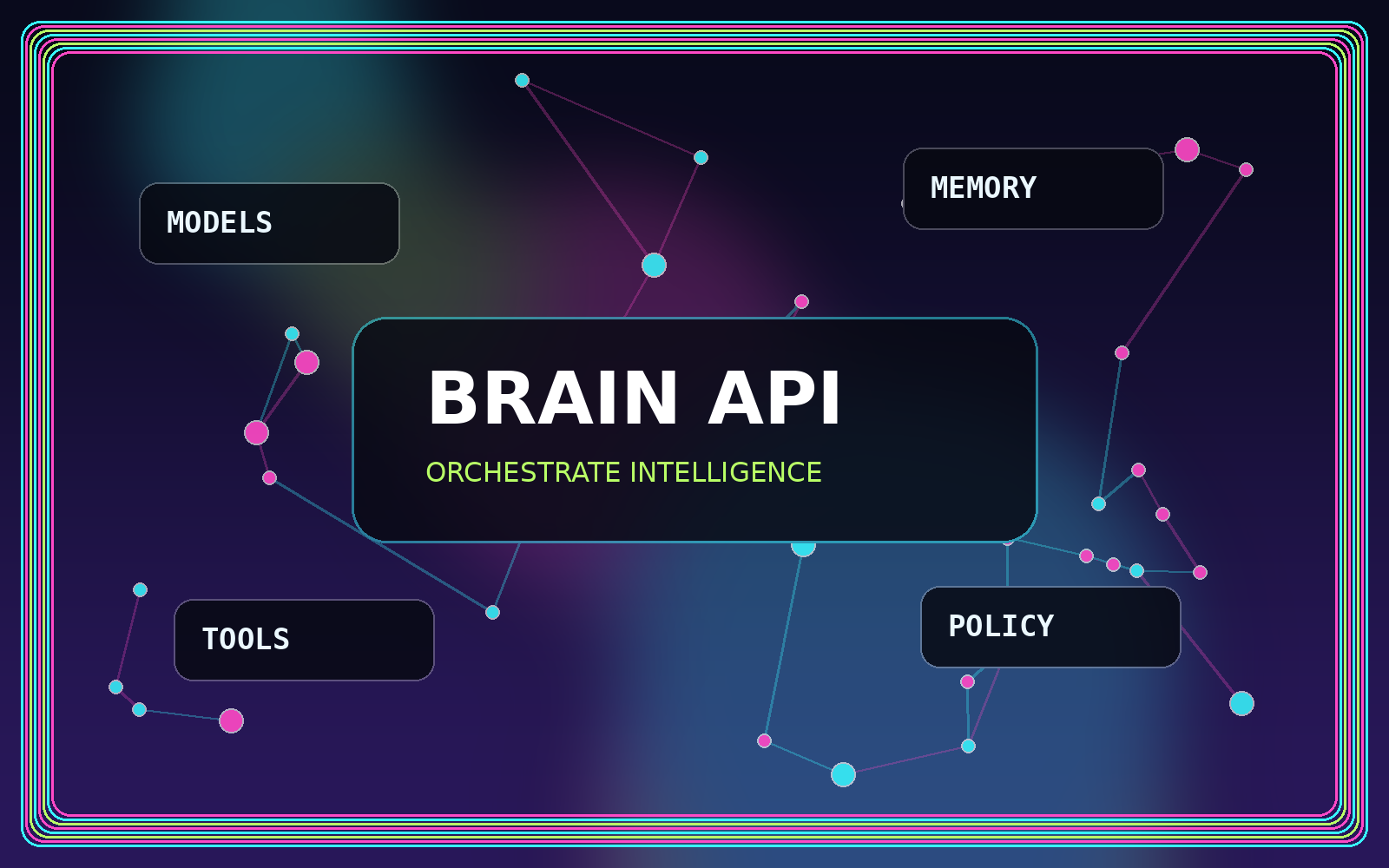
Definition
It is a design pattern for an API layer that interprets goals, assembles context, chooses AI models, uses approved tools, applies policy, and returns a structured result.
The phrase is not one official standard and this site does not claim to operate a live model endpoint. BrainAPI.com explains the architecture behind cognitive services so developers can create stable product contracts while models and providers change underneath.
“Treat the model as one component. The product boundary is the complete loop: context, reasoning, tools, validation, state, and telemetry.”
Reference architecture
Start in one process if needed, but keep responsibilities distinct so they can be tested, observed, and changed independently.
Identity, rate limits, request normalization, service classes.
Files, memory, database records, retrieval, provenance.
Prompt versions, model routing, multimodal inference.
Typed tools, permissions, proposals, idempotent execution.
Guardrails, validation, human approval, safety policy.
Logs, traces, evaluations, cost, latency, analytics.
Explore the system
Use each page as a map to deeper implementation articles and practical release checklists.
Design bounded agent loops with tools, durable state, specialist handoffs, guardrails, and approval.
Choose AI models by task, capability, latency, context, privacy, cost, and measured quality.
Separate neural signals, features, decoded intent, consent, timing, and application control.
Connect CLI workflows, QA tests, Git review, observability, analytics, and safe deployment.
Align video, voice, gaze, spatial anchors, AR, VR, and structured model outputs.
Package local models, route between device and cloud, and operate private infrastructure.
Latest from the field guide
Each guide includes a production checklist and exactly one contextual link to an authoritative source.
A production-oriented plan for self-hosting a Brain API with containers, gateways, model runtimes, queues, observability, CLI operations, Git review, and release QA.
An architecture guide to local AI inference, mobile and desktop model packaging, hybrid routing, privacy, updates, and test matrices for iOS, Android, and Mac apps.

A practical threat model for prompt injection, tool authorization, data exfiltration, secrets, sandboxing, output handling, and red-team tests in a Brain API.
Frequently asked questions
No. On this site, Brain API is a descriptive architecture pattern for coordinating models, context, tools, memory, validation, and telemetry. BrainAPI.com is an educational publication, not a claim of an active endpoint service.
An LLM API exposes model inference. A Brain API sits at the application layer and can route among models, retrieve data, call permitted tools, manage state, request approval, and return a stable task-oriented response.
No. The strongest first version is usually one bounded workflow with one model and a small tool set. Multiple agents are useful only when responsibility, permissions, or evaluation criteria genuinely differ.
Yes. A hybrid design can run selected models and private retrieval on iOS, Android, or Mac while routing larger tasks to a server. The client should make the execution path and data movement explicit.
No. The BCI material is a software-architecture overview. High-impact or medical neural-interface work requires qualified clinical, regulatory, security, and human-factors expertise.
Build from a stable boundary
Define the request, response, tool permissions, state, trace, and evaluation before expanding the feature surface.